The Man Who Became His Own Waiting Room
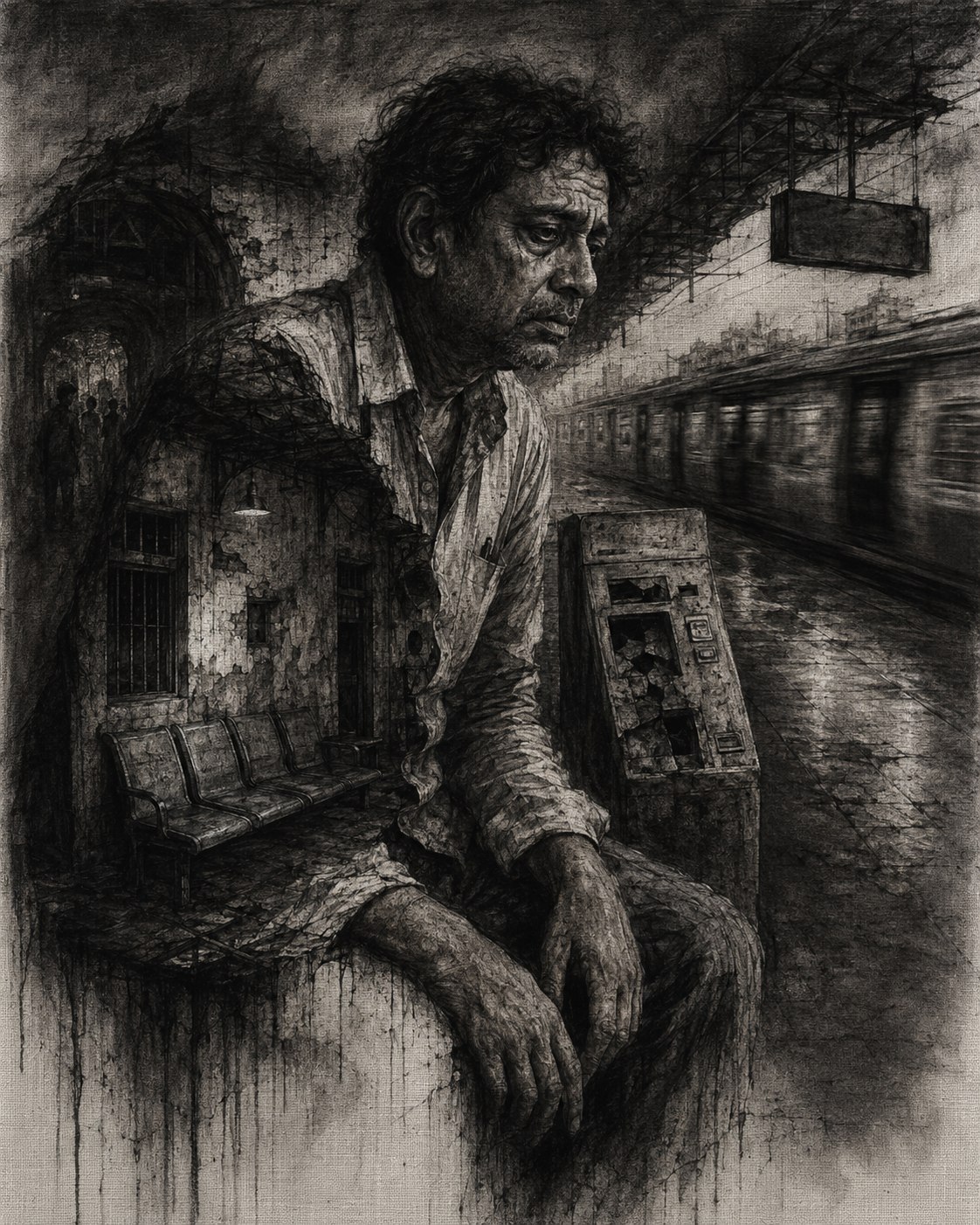
Waiting is harmless only when it has a chair, a fan, and a known ending.
A doctor’s waiting room is tolerable. You sit with twelve other citizens, all looking as if their bodies have filed complaints against them. A railway waiting room is tolerable too, provided the train eventually comes and the tea is not made from water that has seen the Battle of Plassey. Even a government office waiting room has a certain tragic clarity. There is a counter. There is a clerk. There is a file. There is a stamp. There is a man before you who has brought the wrong photocopy and is about to discover philosophy.
But what happens when the waiting room has no door?
That is the problem.
A middle-aged Bengali man in the southern fringe of Calcutta waits for life to restart. Not for a tram, not for a bus, not for the gas delivery boy who always arrives when one is in the bathroom, but for the larger things. Work. Money. Health. Love. Dignity. That excellent old five-piece orchestra, now missing three musicians, one harmonium, and the drummer’s will to live.
At first the waiting feels temporary. A bad patch. A long trough. A weather system. Something passing over the roof with dark knees and bad manners. You tell yourself, let the mood lift. Let the consulting payment come. Let the body behave. Let the head clear. Let the phone ring with one sensible offer. Let one person remember that you exist without first needing proof of income.
Then the days start stacking up.
One day becomes one week. One week becomes a month. A month becomes a species of furniture. Soon waiting is no longer something you are doing.
Waiting is doing you.
This is how a man becomes his own waiting room.
He wakes in a rented room on the edge of the city, where Calcutta has already begun to fray into ponds, broken roads, unfinished buildings, tea stalls, stray dogs, and that heroic dust which appears to have survived every empire. The fan turns overhead with the effort of an elderly wrestler. The phone lies nearby, not as a communication device but as a small rectangular court of judgment. Messages may contain work. Messages may contain insult. Messages may contain nothing, which is sometimes worse.
The kettle waits.
The laptop waits.
The toothbrush waits.
Even the towel has the quiet accusing look of a witness.
Outside, life behaves indecently. Men shout over vegetables. Children go to tuition. A woman bargains over fish with the tactical calm of a field commander. Someone’s pressure cooker whistles. Someone’s television explains the nation in six angry boxes. A scooter backfires like a minor assassination. The city continues, because cities have no shame. They go on even when you cannot.
This is one of depression’s cruelest jokes. It does not stop the world. It stops only your access to it.
Everyone else seems to be boarding trains.
You know this is not strictly true. Many of them are also damaged, indebted, frightened, medicated, overworked, underloved, and held together by tea, installment payments, and family reputation. But depression is a gifted editor. It cuts out their terror and keeps only their motion. They are going somewhere. You are still on the platform.
The ticket machine is broken.
The announcement is unclear.
The train you wanted may already have left.
And some man beside you is eating singara with the calm of a saint, which somehow makes everything worse.
There is a special bitterness in being educated and stuck. A fool can be stuck peacefully. An educated stuck man is stuck with commentary. He has footnotes to his own ruin. He remembers the old life: the foreign airports, the office corridors, the meetings, the spreadsheets, the systems, the long workdays, the words that once had power. Salary. Project. Deadline. Team. Flight. Apartment. Health insurance. Direct deposit.
Direct deposit. What a beautiful phrase. It sounds like money entering your life without drama, like a well-trained cat.
Now money arrives, if it arrives, like a cousin who promised to visit in March and appears in September with no explanation and a plastic bag of guavas.
This is not poverty in the romantic sense. There is no flute playing in the background. There is rent. There is food. There is the electric bill. There is medicine. There is the embarrassing arithmetic of small purchases. Can I buy fruit? Can I postpone the dental work? Can I take a cab today or must dignity travel by shared auto with its knees folded under its chin?
Middle-class ruin is not always a fall from a palace. Often it is a slow shrinking. First the world shrinks to the city. Then the city shrinks to the neighborhood. Then the neighborhood shrinks to the lane. Then the lane shrinks to the room. Then the room shrinks to the bed.
Finally the bed becomes a country.
You lie there as prime minister, opposition, police, unpaid clerk, failed revolutionary, and mosquito department.
The mind keeps producing excellent excuses, because the mind is not stupid. It says, do not act now. Wait until things improve. Wait until the mood is stable. Wait until the market is better. Wait until the body is less tired. Wait until you can present yourself properly. Wait until you do not look like a man assembled from postponed errands.
This sounds reasonable.
That is the trap.
A ridiculous excuse can be kicked away. A reasonable excuse brings a chair and sits down permanently.
So the man waits for the right morning.
The right morning is a famous fraud. It is supposed to arrive cool, clean, and well-lit, with the head clear and the heart cooperative. No toothache. No anxiety. No shame. No heat pressing its damp palm against the windows. No unpaid invoice flapping in the mind like a torn poster. On that morning, he will rise, bathe, shave, answer emails, repair his career, become attractive, earn money, and return to society like a slightly cracked but still serviceable gentleman.
The right morning never comes.
Instead, ordinary Calcutta mornings come. Sticky mornings. Noisy mornings. Mornings with tea leaves, sweat, news, dust, belly acid, and the sound of a neighbor scraping a chair as if dragging civilization itself across the floor. The crows begin their committee meeting. The sun climbs up with the delicacy of a tax raid. The city says, here is today. It is defective, but it is the only piece in stock.
That is the hidden insult and the hidden mercy.
Life does not restart in showroom condition.
It restarts like an old ceiling fan after a power cut. First a click. Then a tremble. Then one doubtful rotation. Then another. Then a noise you do not like. Then movement.
Not beauty.
Movement.
Depression prefers a grand bargain. It says, give me a full cure and I will give you action. Give me money and I will give you confidence. Give me love and I will give you grooming. Give me dignity and I will step outside. This is how the waiting room keeps its tenant. It demands the destination as the ticket price.
But life is cheaper and nastier than that. It often gives only one small handle.
Send one message.
Wash one cup.
Open one file.
Stand under the shower for two minutes, even if you emerge looking not reborn but merely wet.
Eat something that did not come from a packet designed by a committee hostile to the human intestine.
Step outside and buy tea. Not as therapy. Not as enlightenment. Just tea. A clay cup, a little steam, a biscuit that has accepted defeat, and the sight of other humans performing the ancient opera of wanting things.
This sounds small because it is small.
Good.
Small things can pass through narrow doors.
A man who has become his own waiting room cannot usually demolish the building in one dramatic gesture. He has to remove one chair. Then another. Then the dusty magazine from 2011. Then the calendar with the mountain goat. Then the portrait of himself as a finished failure, which is the most stubborn furniture in the room.
The trick is not to become cheerful. Cheerfulness is overrated and often suspicious. Some of the most cheerful people in public have the private emotional hygiene of a fish market in June.
The trick is to become mobile before becoming hopeful.
Hope may come later, limping, annoyed, and underfed. Let it. Do not wait for it at the gate with flowers.
Begin without it.
That is not a slogan. It is a survival method.
There is no romance in suspended animation. No poetry in watching the years pass like local trains you did not board. A man can lose time the way a shirt loses color in cheap detergent, slowly, then all at once. One day he looks up and realizes he has been waiting not for a train but for permission.
Permission from whom?
That is the small mystery at the center of the whole shabby circus.
No official letter was issued. No clerk stamped his forehead. No magistrate declared that he must remain paused until further notice. The waiting room had no legal authority. It had fatigue, fear, illness, poverty, memory, embarrassment, and habit. Strong forces, yes. Real forces. But not gods. Not destiny. Not the final constitution of the universe.
This distinction matters.
A prison with a locked door is one thing. A room you are too exhausted to leave is another. Both are terrible. Only one can be opened by force. The second requires a ruder, slower, less glamorous method: repeated small exits.
Today one exit may be a paragraph.
Tomorrow it may be an invoice.
The day after, a walk to the pharmacy.
Then a call.
Then a bath before noon.
Then a job application sent without waiting to feel like the sort of person who sends job applications.
The world may not applaud. In fact, the world may not notice, being busy with elections, onions, school fees, cricket, traffic, and the latest scandal served hot on television. This is fine. The world has always been a distracted landlord.
The point is not applause.
The point is that the waiting room has been demoted.
From life back to waiting.
From empire back to room.
From master back to furniture.
And perhaps one morning, not the right morning, because that fellow is a fraud, but some ordinary cracked Calcutta morning with sweat on the neck and tea boiling too long, the man rises. Not heroically. Not beautifully. Not with background music. He rises like a reluctant witness.
The fan turns.
The kettle mutters.
The city misbehaves outside.
And the man, still anxious, still broke, still middle-aged, still bruised by his own history, performs one small act of treason against the waiting room.
He opens the door.